Showing posts with label blogging. Show all posts

Writers' Lab: 5 Lessons from 3 years of blogging

on Tuesday, October 8, 2013
On Tuesday, September 14th in 2010, I started PhD Talk. At that time I didn't have much of a defined goal for the blog. The original purpose of the blog, was the following:
"However, there are always better ways to do things, and most of the time you discover this while doing. "
I simply started a blog because I had had blogs (and websites) before, and I thought it was time to pick it up again. My previous blog never got more than 200 pageviews. I just wrote for my family and friends - and that meant my mom and two of my friends would read the blog.

I didn't start with a plan for PhD Talk. I didn't have a posting schedule, a mission statement, a decent following on Twitter - I just started.

For the first months, I was simply writing every now and then, without getting much traffic or comments. But gradually things started changing. Posts got retweeted. Marketing and Communications of TU Delft caught sight of my work, and gave me a pat on the back. And after a while, I started to identify as a blogger. I landed guest posts for a number of big blogs, live-blogged twice for TEDxDelft and became a permanent author at Grave Concerns E-zine, Lifehack and Gradhacker (which ended when I finished graduate school). I received some freebies here, a store voucher there and some Amazon credit elsewhere. And I'm extremely grateful for all the support of my readers. Thank you!

1. There's value to academic blogging


After some time of writing at PhD Talk, I boldly stated that blogging is for every single academic, which triggered the discussion of the added value of blogging to academia. That doesn't translate into: "every academic should start a blog". I think there lies a lot of value in guest-posting, or in universities paging their staff every now and then to write something, showing their work and/or view on a hot topic.

By sharing my presentations online, and making my research topic visibly linked to my name, I've received e-mail messages from colleagues worldwide to discuss my experiments, and share some of my papers. Without an online presence, I would have never had the opportunity to make these contacts. Conferences, yes, also - but conferences are a different dimension, with a different audience. The internet adds an additional layer to this experience of knowledge exchange.

2. Writing about new topics triggers learning

Researching topics for TEDxDelft and Lifehack has been an incredibly rewarding experience. I've learned to make a quick search for a topic that is completely new to me (say: sulfur concrete), analyze the available information, spot the caveats, and then try to explain it in plain English to a broader public. By developing this skill, I've expanded my writing skills beyond what I could have possibly learned in academia, yet my academic writing has significantly benefited from this.

3. Practice produces speed

I used to need an hour to write a CD review, it now takes me 20 minutes - because I have fine-tuned my approach. As for blogging, it depends on the post - but certainly my ability to form sentences has seen an increase in speed. And likewise, writing sentences for research papers now goes much faster.

4. Building connections helps growing a blog

It's the guest-blogging, the Twitter connections and the community of fellow academic bloggers that have helped me grow PhD Talk. If I'd have stayed in my own corner, fiercely typing away the hours, and not interacting with anyone, I don't think PhD Talk would have received the exposure it has today.

5. Building a community is difficult

But exposure is one thing - building a community with an engaged audience is another thing. I haven't discovered yet how to engage my audience as much as I would have liked. Posts don't get much comments. Things seem to be static, rather than dynamic. All discussion happens on Twitter, not on the platform of PhD Talk itself.

For sure, I'd love to keep on building this blog, and my own domain would be the first step. But I have to confess I prefer writing over tinkering with the layout and workings of the website itself. That change can still come, over time. Most likely, that e-book will come sooner, though.

By all means, stay tuned for more posts here at PhD Talk. If all goes well, I'll keep it up for yet another 3 years (and onwards).

What have you learned from blogging? What would you like to see featured at PhD Talk?


Writers' Lab: Improving narrative in multidisciplinary projects through blogging

on Tuesday, September 17, 2013
As a starting point for today's post, I've chosen Maria Konnikova's excellent blog post on "Why grad schools should require students to blog".

Previously, we've looked at the benefit of blogging for your scholarly work, and how it can be valuable for every single academic. Moreover, we've discussed the possible reasons for blogging - there are many different paths you can take to blogging as an academic.

Earlier on PhD Talk, we've looked at how academic writing can make us better writers. Maria Konnikova shows us how popular writing can make us better academic writers, and how that can increase your chances for success in graduate school, or in her words:

And partway through another all-nighter (I was working under some tight deadlines), I had an epiphany: thank god I’ve spent the last few years blogging, writing a book, and doing freelance journalism. Otherwise, I’d be lost. Truly.

During that epiphany, she realized there is not much of a difference between on the one hand researching for an article for a magazine, bringing material together from different sources, and on the other hand writing about multidisciplinary research, reconciling two different fields of study and their own vocabulary.

As Konnikova explains how she came to an article that turned out to be a goldmine for her research, it is once more clear that it is not through sheer luck that she stumbled upon this piece, it is because blogging thought her to research widely. By the same token, it strengthens my belief that reading sparks creativity, and that grazing around in the literature, wandering off on undiscovered paths might lead us to unexpected goldmines. In Konnikova's words:
To me, as a blogger, cross-citation is standard practice. I have to do it every day when I research a new blog topic or look at the background for a new piece. It’ s natural to include anything that may potentially be helpful—and to put areas in dialogue even if they don’t normally cross over. I don’t feel compelled to stay within any arbitrary academic boundaries; I just use what seems most, well, useful.

She also proposes the following:
I’d go a step further: incentivize students to blog and to write for a popular audience on topics that go beyond their immediate area of interest. At Columbia, for instance, we can write a grant for one of our comprehensive exams. Why not let a series of published blog posts count as well?

Taking this idea one step further, we could recommend multidisciplinary research groups to write posts on a group blog, and practice writing in a style and language that is accessible for all different backgrounds involved in the project. We could invite groups to learn to speak eachother's language by sharpening their narrative into a common ground.

PhD Talk, post PhD

on Thursday, August 1, 2013
Dear lovely readers,

Some of you have wondered what my plans are for PhD Talk now that I have graduated and am not a PhD student anymore, so I thought a small glimpse into the future is in place.

My most honest answer to this question is: I'll keep working on this blog for as long as I enjoy doing so.
At the moment, I'm still very much enjoying writing here, and sharing my thoughts, adventures and lessons-learned with all of you.

In the Fall semester, I'll be moving to Ecuador to start as an Assistant Professor at Universidad San Francisco de Quito. As a result of that, there are a few new topics that most likely will appear here, such as:
  • Life as an early career researcher
  • Teaching (I'll start with 3 courses of my own)
  • Expat life in Ecuador
  • Moving abroad

By the same token, I still have a number of topics on my sleeve related to the PhD process that I will frequently share with you all.

I keep on aiming at three posts per week, as long as that remains feasible.
If possible, I'd like to incorporate more guest posts from aspiring, current and former PhD candidates. If you're interested, don't hesitate and get in touch with me!

Also, I -not so- secretly aspire writing an e-book that assembles all that I learned while writing my dissertation: stay tuned!

Over the past years, I've seen (too) many fellow PhD students getting stuck in the swamps. In my research group, I pretty much graduated before all the folks that started their programs earlier than me (and I don't want to sound snobbish about that, just matter-of-factish). I finished and defended 2,5 months before the end of my funding, while the norm at my institution seemed to be extensions, and sometimes even unemployment checks.
For full-time PhD students, I think it is perfectly possible to finish on time, within the originally devised time schedule. Unfortunately, a lot happens along the way, many things don't go as they should, and I would love to improve the system - one PhD student at a time. So tell me, how can I help you?

Let me know what support you are looking for, what you would like to learn about and what you'd like to see on this blog. I'd be more than happy to give you a little boost when needed.

Writers' Lab: A Writing Diet

on Tuesday, March 19, 2013
My thesis, after the help of Mr Kitty
Do you have a plan for improving your writing?

Or do you simply assume that one glorious summer morning, you will open your laptop, start typing your dissertation, and finish happily a few months later?

Do you assume that you can get a journal paper published without practicing your writing?

If you are a non-native speaker, do you think reading a few English papers is enough practice for your English? Maybe watching movies counts too?

One of the most powerful decisions I took during my PhD*, was to take writing very seriously.

I put myself on a diet of writing.


With even more determination than my plunge into the literature (I read a little less than 700 papers and reports during my PhD), I decided that writing is the single most important communication tool in academia.

Your dissertation depends on your writing skills. Your publications depend on your writing skills.

If you read academic blogs, you will find tons of posts on writing - because it's so important.

I started the writers' lab - because writing is so important.

For my writing diet, I decided that I would write as much as I could, about as many things as I could.

To give you an idea, here's a list of the many different ways in which I tried to improve my writing:

1. Test reports
The complete description of my experiments is reported in 3 massive reports.

2. Background reports
I tried to keep the number of pages in my dissertation limited, so my theoretical work is described at length in a few background reports.

3. Paper summaries
In the beginning of my PhD, I wrote summaries, critiques and comparisons of the papers that I read. I compiled documents in which I compared all the references reporting on parameter Y on the shear capacity.

4. Analysis reports
I kept a clear distinction between the pure observations of the experiments, and then the lessons learned from the experiments. The parameter studies and comparisons to the code predictions are all reported in separate analysis reports.

5. Meeting preparations
I often prepared short summaries of my work to discuss at meetings with my funding organization.

6. Conference papers

I've been around a bit over the past years, so you can say.

7. Journal papers
Something that is becoming more and more a priority for myself is working on my papers. I published some of my experiments already, but I've identified 11 papers that I would like to write from the material in my dissertation. It's of course not granted that any of these will get published, but at least the idea is there.

8. The dissertation
This guy simply doesn't need more information. I'll bombard you with pictures once the baby is printed and published.

9. Blog posts

Since September 2010, I've been writing here at PhD Talk, and I've settled for 3 posts to be published per week.

10. Guest posts

As you can see in my list of guest posts, I've been writing posts for other websites regularly. Especially the last few months, I've tried to write a guest post every week.

11. CD reviews

Since October 2012, I've been reviewing new releases for Grave Concerns. Writing CD reviews is yet another skill, and I've clearly noticed a learning curve in here.

12. Journaling
First in 750 words, and then in a pretty Moleskine, I've been just blurting out sentences on paper without really caring for what I write. it's incredibly liberating.

In practice, my weekly meal plan writing plan looks like this:
- at least 2 hours of writing for my research every workday
- 7 days of journaling
- 2 CD reviews
- 3 posts for PhD Talk
- 1 guest post

Do you have a clear plan for your writing? Or do you just wait and see and hope for the best?

* I'm almost finished and scheduled to defend, and thus I think you allow me to look back on the past years already.

Can Blogging add an Additional Dimension to Academic Publishing?

on Sunday, December 9, 2012
This post continues the ideas on blogging to tackle publication bias, and blogging for all academics.

As USC Rossier reacted on Twitter by wondering if blogging could overtake peer-reviewed journals, an interesting discussion followed. I storified it for your interest!

Why Blogging is for Every Single Academic

on Thursday, December 6, 2012
In my vision of the future, blogging is as much a part of the academic world as peer-reviewed journal articles.

There are several reasons for blogging, and blogging as well as more online sharing, could tackle publication bias.

But at the same time, I notice a lot of reluctance when it comes to blogging. Two years ago at the PhD Event, the Online Networking and Social Media workshop ended up in a long list of complaints and reasons why to stay away from the Big Scary Interwebz. This year, the workshop I intended to give at the Network Day of Utrecht University had 0 interested persons.

So, scholars 2.0 should acknowledge the fears and doubts of their less-internet-oriented peers and address these fears more specifically.

I'm giving you my 2 cents here, hoping that I can spark some interest in doubting academics:

1. Privacy

Online identity protection and concerns with regard to privacy are a major concern. However, if you are active online, you really have more control over your online identity than when you try to fully stray away. In a way, if you try to avoid to have anything about you or your work online, you fully depend on others who might still distribute content that contains your name.

If privacy, or not publishing of your contact information, is your main concern, then you can think deeply in advance on how much of your data you want to provide when you write something. The key here is to always think twice when you fill out a form online and check if your data will not be shared with others.

2. Fear for writing something "stupid"

A fear I can fully relate to... In the past, I've deleted complete blogs (like the blog I kept on my MySpace), because I didn't like the contents anymore. I've also wondered if it can happen that I write something about my research, which then would venture out into the interwebz and lead a life of its own, grow teeth and come and bite my in the ankles.

However, if it turns out I wrote something that turns out to be discredited by other research, I'd be more than willing to discuss it here. Sharing knowledge leads to advancing the entire body of knowledge, and I prefer to write, and fail if necessary, than to keep my thoughts to myself.

3. Lack of time

We're all more than busy: research, education, administrative tasks, preparing a trip for a conference and some more activities all keep our schedules more than full. However, when you consider starting to write online as a blogger, you should reflect before you start. If you don't have the time to keep a blog alive, having your own website or blog might not be the way to go for you.

But that doesn't mean blogging wouldn't be suitable for you! There are many ways in which you can still contribute online, even though you don't have the time for your own page: you can guest blog, or your faculty or research group might start a blog in which all involved researchers can take turns and provide content when their schedule allows them.

4. Lack of ideas

Another commonly-heard grumble is "I don't have good ideas to write a post". You don't really need to sit with a coffee and cook up a Great Idea. There are many ways in which you can share your knowledge online. In this post, you can find a few ideas on which contents you can quickly turn into a post. I'd add to that, writing a post to discuss a conference you visited, to share a presentation you gave (slides and a brief summary), write an entry when you have a new publication and -specifically for PhD students- giving an update of your work every now and then.

How would you convince a fellow academician to take the plunge and write online?

What I learned from liveblogging

on Saturday, October 13, 2012
I've already mentioned it so many times here that I had the privilege of being a liveblogger for TEDxDelft, but in this post I would like to focus on liveblogging itself. Two times I have liveblogged as of now, both at TEDxDelft (2011 and 2012), and I certainly have some take-home lessons that I would like to share with you.

First of all, I think liveblogging is unlike anything else. Writing at the brink of the moment not only causes incredible focus in me (I am going to tap into that zone for my thesis), it also helps me to think fast and build sentences in a snap.

Just like last year, I managed to write 4 entries for the website over the course of the day, and I did some tweeting along the way. But this year, I had a better plan, and I'd like to share that with you:

1. Preparation is key

Unlike last year, when I showed up, opened my laptop and gave it my best shot, we had a plan this year (thanks to our webcare team leader @marionvanputten). I knew exactly which performers I'd be writing about, and I had done my homework and researched them before the event. Although I still had to look up some things while writing the posts, I did feel much better prepared, and with more background knowledge.

2. You can't cover everything

Last year, I tried to listen to all talks, read all tweets, hear, see and follow everything around me - and in the afternoon I was completely overloaded and with writer's block. This year, I knew which performers to cover, and made these my priority

3. Stop and pause

In between writing about the performers I was supposed to cover, I took a moment to let my mind wander, stretch my legs, make a phone call and refuel. This year I did not experience any writer's block at all.

4. The zone

To deliver the best liveblog posts on "my" performers, I went into the creativity zone from the moment the performer stepped on the stage to the moment I hit the "publish" button in WordPress. I followed every step, expression, word and emotion of the performer, made notes and started writing after the performance. At the moment that I started writing, I chose to block out all external noise and blast some loud music in my ears (Dark Tranquillity in the morning, random futurepop in the afternoon) - such that I could be away from the world and get going with writing. I managed to experience some incredible focus by doing so.

5. Don't forget to eat and drink

My take-home message for next time: don't forget to drink! I certainly didn't drink enough water during the event, so I woke up with a headache the next day. A mistake not to be made again!

6. Sit straight

Another take-home message: I should keep my toes warm and sit straight. After a day of hanging in a chair hunched over my laptop, I felt like an old lady with a broken back the next day. My feet got cold and rained out in the morning, and sitting still made all joints from the hip to the toes hurt. The same sometimes happens when I work from home...

Here's the catch: I came to realize many of these observations count for thesis-writing as well. The time pressure and the "now" might not feel that urgent while you write a chapter, but try to tap into that creativity zone, and I'm sure the words will start to fly onto the screen.

TEDxDelft LiveBloggers

on Sunday, October 7, 2012
At TEDxDelft, I had the opportunity to be liveblogging in the company of some inspiring writers. The atmosphere in the webcare room was of utter concentration and team spirit at the same time. We all worked hard and arrived to the venue in the very early morning to get started, and I think we can be really proud of all the articles on the TEDxDelft website. Since I can't make floral art like Pim van den Akker, I'll just say that I felt honored to be writing in the company of these wonderful people - and I think you should go and check out their blogs!

2 Flow with Eve: (in Dutch) on working towards a new world of work at Delft University
The Self Help Hipster:  PhD Student in distress, go and read how to improve your condition
Merel graduates: giving you a glimpse of the final year of Merel's studies
la susea: inspiration on design, art, travel, photography and living in Holland
Clineschrijft: (in Dutch) #blogbriljant: bouw een briljante reputatie met je blog
Mandy: (English/ Dutch) on all that catches her attention as a designer
EmmaMedia.cc: (in Dutch) social media and online marketing
Eye on Orbit: on space exploration
Zielsgenot en Pijn: the world of Carolien, recovering from a burn-out
De TekstGroep: Website of journalist and writer Hans Dalmeijer

Live blogging at TEDxDelft

on Monday, November 7, 2011
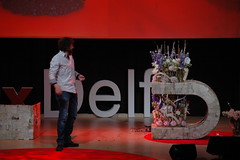
Just a quick note: I'm live blogging from TEDxDelft today - and trying to keep a good shot of science and inspiration together.
All articles will appear here