Showing posts with label Erik Schlangen. Show all posts

Smart Materials, Made in Delft

on Tuesday, December 18, 2012


 We’ve introduced Erik Schlangen as Professor “Experimental Micromechanics”. But what does that really mean, and where does he wants the research of his group to result in? In his own words: he wants their inventions to show up when you Google for “future materials”.


Now let’s consider for example concrete. With very simple and archaic tests, such as the slump test and the compressive test, engineers derive the properties to build our skyscrapers and bridges.


Nowadays, the requirements for concrete are much more complicated though. We can add steel fibers for better performance, reduce the amount of cement for a greener concrete and add retarders and superplastifiers to increase the workability. In the end, we have much more ingredients than the original sand, cement, stones with some water to make it fluid. So how representative are the very basic experiments that we use to derive the properties? Erik and his team aim at finding a way to explain how the material fails.
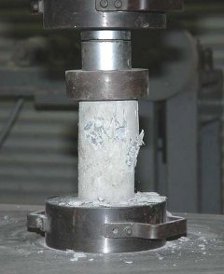

To explain how complex materials such as the improved concrete fail, better measurement techniques and testing machines are necessary, as well as detailed material models to support these tests. But these techniques and models not only allow the researchers to better understand existing materials – they help them to go one step further and develop better materials.

Very flexible materials, green concrete containing wood fibers, and materials that can heal themselves show us a way into the future, in which we tailor our materials to fit our requirements “a la carte”. Concrete that closes its cracks by using bacteria, and asphalt with steelwool fibers have already been invented by Erik and his colleagues, and now they are studying, amongst others, the fracture properties of graphite as used for the cores in nuclear reactors, and the properties on the interface between the stones and the cement in concrete, two different parts which can come apart.

And what will the future bring? Future materials in Google? One thing is for sure: Erik’s cheerful approach to smart materials reminds us of the eager explorations of our younger selves. Never grow up…

You can view Erik’s presentation at Civil Engineering on his professorship at Collegerama

This post originally appeared on the TEDx Delft website.

Taking the Lab to the Stage

on Tuesday, November 27, 2012
Erik Schlangen looks at cracks in buildings and roads, and considers the material to be ill, not broken. And the ill patient can be healed, as long as initially he contains some simple tricks.


In utter silence, a scientist in lab coat shows up on the TEDxDelft stage, and then there is also a lot of smoke around his small lab setup – you would think Professor Barabas has walked out of your childhood comics. Still in silence, a sample of asphalt broken in two pieces is put in a microwave.

And then we learn what is going on. Regular asphalt has two main disadvantages, Erik explains: water stays on the surface, resulting in splash water and puddles, and driving over asphalt results in high levels of noise, which is a disturbance in a densely populated country like the Netherlands.


Luckily, a solution was found by developing ZOAB (very porous asphalt concrete). As the name says, it is a very porous material, which means that water can drain right through it, and it also works as an insulator for the traffic noise. The architecture of the material is that it is mostly aggregates (stones), with a very small layer of bitumen keeping the stones together.

If you want to know more about asphalt, and how it is made (explained with wonderful cartoons), check out this TEDx talk by Dr. Niki Kringos:


The advantage of the ZOAB is however closely knit to its disadvantage: it wears out easily. The layer of bitumen shrinks, cracks and ultimately causes the connection between the stones to get lost. Raveling occurs, stones come off the surface of the road and can damage your windshield or create potholes.

However, with some smart tricks inside the material, the service-life of the roads can be doubled. The brilliant idea is to mix steel wool fibers into the bitumen. Steel conducts heat very well (compare to placing a steel pan on a stove), and if you add steel fibers to bitumen, the road can be repaired by using heat. Under the influence of heat, the steel fibers will warm up, and melt the bitumen again such that the cracks disappear, and the road is ready for a second round.

After extensive testing in the laboratory, it turned out that a road from self healing asphalt can be used twice as long without needing replacement if it is heat-treated (with an induction machine) every 4 years. With the simple trick of adding steel wool fiber to the bitumen, the government can thus save a lot of money.

The performance ends as it began, with the focus on the lab on stage: the asphalt sample in the microwave is ready. And then the moment of truth, when Erik only holds the top part of the specimen: yes it works, the asphalt specimen that was broken into two parts looks as if nothing happened!

This post originally appeared on the TEDx Delft website as a live blog.