Showing posts with label thesis. Show all posts

On the road to the defense, part II

on Thursday, July 25, 2013
Right after the defense, with my husband, paranymphs, full committee and the Beadle
I'm writing the second half of my experiences in the final year of the PhD towards the defense here in hindsight, as I defended successfully on June 14th 2013 and received my PhD degree the very same day.

Previously, I described what happened between finishing my draft dissertation in November 2012 and sending copies out to the committee members in February 2013. In this post, I will continue where I left off in February 2013, and describe those messy final months of working on a doctoral dissertation.

9. Get the comments from the committee members
Most of my committee members preferred in-person meetings. Luckily, most of my committee members are based in Delft or often in Delft for meetings, so that I only had one long train ride to Germany for a meeting. During the meetings, the committee members gave me their input in many different ways. Some preferred my talking them through the dissertation, some interrogated me on topics more related to their field that I implemented into my work, some focused more on the layout and writing style - every reviewer seemed to have his own style of assessing my work.

10. Implement the comments from the committee members
With my piles of notes from these meetings, as well as the pages of comments from the final committee member in London with whom I didn't meet in person, I set off to make some changes to my dissertation. It took me about 6 weeks of full-time work to implement all the comments and respond to all the questions in a way that I felt was satisfactorily. With some committee members I met several times to improve large chunks of my dissertation, or I e-mailed back and forth with them. At first I was surprised as I thought "the work was done", but then I understood how valuable a fresh look at my work can be, not only for my dissertation, but also for my further publications (ie. the papers that I need to write from my dissertation)

11. Iterate if necessary
I felt at times intimidated by the knowledge of some of my committee members, so I felt afraid to ask for their help and input at first, and spent some time studying topics where I felt I was still lagging behind. But then it clicked, and I understood that if they take the time and effort to give some thorough remarks on my work, that they actually show me that they want to help me improving my work. So I went back and forth, learned more things, saw a few more connections in my work and genuinely made a better (yet almost 100 pages bigger) dissertation.

12. Get the approval from the committee members
I remember how my heart jumped up when the final committee member strolled into my office with his "signature". The committee members all need to sign two documents for the Beadle: the first one confirming their availability on the day of the defense and the second one their approval. One of my committee members approved under the condition of making corrections to the dissertation, which then required a written letter from my promotor and additional approval to keep the whole (bureaucratic) process rolling.

13. Revisit with promotor and copromotor
After editing my dissertation, I revisited the work again with my promotor and copromotor, and we needed to tighten my set of propositions (ie. a leaflet with 10 propositions additional to the dissertation that shows your scholarly insight). With a conference in Israel in between, I felt that time was ticking - and that those 4,5 months of preparation that seemed like an eternity where flying by.

14. Send to the printer
With all approval from the full committee, I sent everything to the printer. In the final weeks of working on the edited version of my dissertation, I spent some time in layout-hell, trying to make sure everything fit within the margins (I needed to revamp an entire Annex for that purpose), and making sure all tables are on portrait pages (I used a lot of landscape tables to hold all my data). I sent a draft to the printer before the critical date, and was reminded as well of the fact that all chapters should start at a right page. Lots of tinkering before sending it all off to the printer, as you can imagine. In the meantime, I had a designer at the printer's office developing my cover and invitations - which saved me time for sure, but needed my attention and input as well.

15. Check the print proof

I got my print proof even earlier than the schedule of the printer indicated, and I was very happy to hold the very first physical, book-like copy of my dissertation. I didn't really know how to check the proof: reading from A to Z felt pointless to me, so I ended up going over every page and checking if all looked right - and I did find quite a number of things that did not look as I wanted (yet looked exactly the same as the PDF I delivered to the printer).

16. The final order and delivery
I made more edits, then struggled with the PDF conversion for a few hours. The print-proof arrived right before the start of a conference in Rotterdam, so for the very first time (and equally last time) in my PhD studies, I had to cut back on some sleep to get through the final edits and make it in time to deliver everything to the printer. On the 17th of May, I received a call from the goods delivery point of our faculty that there were "some boxes" for me - and so started my journey to drag my 250 copies of my dissertation into my office...

17. Spread the word

I took the stack of business cards that I had amassed from previous conferences, and started mailing out copies to interested contacts (or at least, contacts that I thought would be interested). I also had two more conferences, 1 in Japan and 1 in Pittsburgh. I took an entire carry-on bag filled with copies of my dissertation, and distributed these during the conferences. By the time of my defense I had about half of all copies distributed.

18. Prepare for the defense

I didn't really know how to prepare for my defense, and I'll write a post about it specifically in the future, but essentially I didn't have much time for preparing my defense all in all. Certainly, I had to prepare my "lekenpraatje", and I reread my dissertation once more, but preparing for possible questions was a little more vague. I summarized my dissertation in a sentence per page, as suggested by Phillips and Pugh, I went over my meeting notes again, and I tried fishing for information from my committee members (unsuccessfully).

19. Defend

Less than a week after landing back onto European soil after my trip around the world to Japan and the US, I got over my jetlag (mostly) and defended my dissertation. I was nervous at first, but after the first question, I felt my confidence returning to me, and I sort of enjoyed showing my work to the committee members.

20. Celebrate!
After the actual defense and receiving my degree, I organized a reception in the TU Delft Aula building, and in the evening a dinner in a restaurant in Delft (plus some drinks afterwards in a bar). Even though I was exhausted from the stressful day, I was feeling uplifted and enjoyed celebrating my fresh degree very much (well, who wouldn't?).

How different are the preparations at TU Delft and my take on them from your institution? Please let me know in the comments!

Defending tomorrow!

on Thursday, June 13, 2013
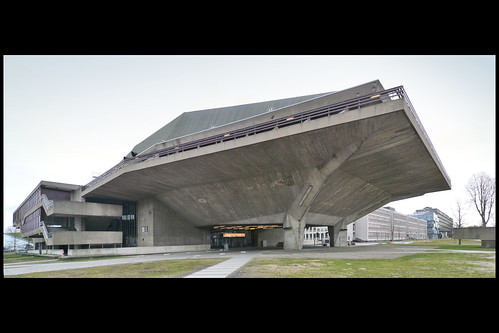
Defending in Delft's spaceship tomorrow!
Tomorrow, on June 14th of 2013, at 12:30 I will defend my PhD thesis and propositions in the Aula of Delft University of Technology.

This is what my day will look like:
11:45 arrival to the Senaatszaal
12:00 presentation for friends and family, without the committee
12:30 Committee enters, and the defense/interrogation starts
13:30 end of the defense, the committee leaves
13:45 graduation ceremony (if all goes well)
14:00 reception at Aula
18:00 dinner with friends and family to celebrate

I'm almost finished!

Writers' Lab: How to put a landscape table on a portrait page

on Tuesday, May 21, 2013
One of the major moments of intense frustration I went through in preparing the final draft for my dissertation, was the moment when I needed to revert the landscape pages that contained large tables back into portrait pages.

Why was that necessary?
The printer/publisher needs to have all pages as portrait pages, 17cm x 24cm. Landscape pages should either be rotated, or given as portrait pages, with their contents turned 90 degrees.

I opted for turning everything back into portrait pages, so that I could have my headers and footers uniform throughout the document.

So, I searched online on how to put a landscape table in a portrait page. It looked easy, make a textbox, paste the table into the textbox and turn the textbox 90 degrees.
The problem is: if you convert an MS Word document into a PDF file, these textbox-tables show up as completely empty. I tried different PDF convertors, some of them already crash on the size of my dissertation, all others leave a blank where my table was supposed to go.

After going way over my boiling temperature and feeling ready to throw my chili con carne over the grumpy security dude of the building, I finally found a way to work around this problem.

So, if you meet the same guidelines for the printer/publisher of your dissertation, these steps can help you out:

1. Have you landscape table in MS Word.
2. Convert that one single page with that table into a PDF
3. Open that PDF in Adobe Illustrator.
4. Clean out the "damage" (in my case; the font Times New Roman Bold Italic went lost, and some greek symbols showed up as a crossed-out little box).
5. Clean out everything that doesn't belong to the table.
6. Save the table as an .eps file.
7. Import the .eps file as an image into your MS Word document.

Yes, this method is really tedious, but at least it will print correctly in the PDF document that needs ultimately needs to go to the printer.

Happy dissertating!

On the road to the defense, part I

on Thursday, February 14, 2013

Ladies and gentleman, this is the beginning of the end! I am scheduled to defend my PhD thesis on
June 14th 2013 at 12:30 pm
at the Senaatszaal in the TU Delft Aula.

During a defense at Delft University of Technology, the PhD Candidate gives a presentation for friends and family (and not the committee), after which the real defense starts and this lasts exactly for an hour. The Beadle (lady at the right in the photograph) marks the beginning and the end of this hour. Then, the committee retreats, and then the commencement ceremony starts. So, you could say that it's a bit of an all-in-one experience.

Since a Dutch defense is super formal, it takes quite some steps before actually getting to the point of the defense. I'll blog about this process (you could have seen that coming), and today I'm giving you an update of the steps I have gone through so far. 

My goal for writing these steps out is to give PhD candidates at Delft University of Technology a heads-up on what they can except at the end, and to explain the rest of the world why it takes so long from finishing the draft thesis to defending.

1. Finish draft thesis
I finished and delivered my first full draft on November 14th of 2012. This first draft was a compilation of all the chapters I had written previously. As my promotor and copromotor worked their way through the document, I started adding the list of notations, summary, acknowledgements and curriculum vitae - as well as try to make my drawings look a little better (still something I struggle with).

2. Improve draft thesis with promotor and copromotor
During the months of December and January, I went through 4 rounds of sitting with my promotor and copromotor. The first three rounds were all aimed at getting their feedback on my chapters, and the final round was for me to show them how I implemented their comments and how I extended my theoretical work.
 
3. Acceptance of draft by promotor (PROM3)
That was The Big Day. We call it "getting the signature". It means that your promotor signs the form PROM3 - which actually clears your road to the defense. For me, this happened on January 29th - and I won't forget that day easily. I had caught the flu, was roaming around with a high fever, sweat dripping down my back and abdomen, nervous as hell as I knew I'd get my Yes or No... and I felt such joy and relief when I had the form signed and well in my hands.
 
4. Compilation of committee
There are strict rules in the doctoral regulations with regard to the thesis committee. The committee consists of the rector magnificus, promotor, copromotor, 5 more people and a spare member. A given number of these need to be full professors, a given number should not have been involved in the research and a certain number needs to be from outside of Delft University of Technology. It's a bit like counting little dolls - check if you have enough of each set in your collection.
 
5. Get a defense date from the Beadle
The minimal amount of time between getting the signature on the defense is 11 weeks. I rushed out right on the 30th of January to get a possible defense date, and the earliest option that suited the Beadle, my promotor, copromotor and myself was -gasp- June 14th at 12:30. That's 4,5 months to prepare...
 
6. Ask the committee if the date suits them
Here's the tricky part: you simply need a number of (full) professors that are available on your given defense date. As finding the date with the beadle is so much of a hassle, we ended up replacing one committee member and keeping the date.
 
7. Final committee and send drafts
When all that's set and done, and the final committee is compiled, it is time to send out good old fashioned hard copies of the draft thesis. I sent my last copy on February 4th. The compilation of the committee is then finalized on documents PROM4 and PROM5. As my committee changed, I need a new signature from my promotor, who unfortunately will only be back on February 18th.

8. Pause
Sit back and relax? I'm still working on improving my draft. I keep finding typos, and sentences that don't flow as I would like them to. And my figures still look as if they've been drawn by someone who only learned how to draw in Illustrator about a year ago...

To be continued...

Thesis Distance: Inner resistance

on Sunday, December 2, 2012
Mid November I finished the first draft of my thesis, printed it and handed a copy of it to my 2 supervisors. Shortly afterwards, I headed to Pittsburgh for holidays. I intended to take my thesis print with me, and proofread it in the beautiful library of Pittsburgh.

And then, I decided to take a step back.

I decided to take a Real Holiday and not to touch my thesis until returning.

I forced myself to create a distance between what I wrote and myself.

And to be honest, it was very hard. Here, I give you some insights in why I found it difficult to take a break (you'd think I'd be more than happy to relax after such a big effort, no?):

1. Tunnel vision

For many months, I have been planning my writing and have been focused on the thesis and the thesis alone. Finishing the thesis not only became my first priority, but also took over my entire mind. Realizing how much of tunnel vision I am experiencing is already one step towards returning to the world outside of the thesis again.

2. Stress

Admittedly, I am terrified by the idea of not graduating within the 4 years of my program. It creates a certain type of stress that makes me act like a hamster in a wheel: keep running keep running and keep busy to make sure it will all get done in time.

3. Perfectionism

I dislike the opening lines of my first chapter. I've wanted to change them around again recently, but I decided that instead I should ask the opinions of my supervisors. As a perfectionist, I want to keep on editing my text and polishing it and proofreading it. Again, taking a step aside and waiting two weeks to continue working on my thesis, helps me to reflect on which editing is necessary and which comes out of perfectionism.

Have you walked away from your thesis at a certain point in the process? I'd love to hear your stories in the comments below!

Thesis Update

on Tuesday, October 30, 2012
My contract with the university ends at the beginning of September 2013. And no contract means no salary means Big Trouble. To avoid Big Trouble, I will finish my PhD before my contract ends. Yes, it's that easy.

Well, maybe not. Maybe finishing a PhD takes a little more than just the fear of Big Trouble. Maybe it requires pushing through really hard to make sure I can finally go and live in the same place as my husband. Maybe it takes a little anger and a spoonful of frustration.

With 10 months on the countdown, things do look quite good here, and I thought it's time for an update on my thesis.

I'd like to go chapter by chapter, to illustrate what I still want to do.

Chapter 1: Introduction: Finished and got feedback from co-promotor and promotor. I do want to go over it once I have all chapters finished to see if the description still covers the contents.

Chapter 2: Literature Review: Finished and got feedback from co-promotor and promotor. I want to go over it once more and put more emphasis on the theory I ended up using for my theoretical work.

Chapter 3: Experimental Results: Finished and got feedback from co-promotor. I think it's done done done, unless my promotor has comments.

Chapter 4: Parameter Analysis: Finished and got feedback from co-promotor. Not sure if my promotor agrees with the way I structured the chapter....

Chapter 5: Modified Bond Model: Aka my theoretical chapter. It's in progress, and I really hope to finish it next week - unless other work is going to get in the way again.

Chapter 6: Probabilistic Assessment: I still need to implement to comparison between the Modified Bond Model and my experimental results in there, but the bulk of the chapter is finished. I sent it off to prospective committee member because he's an expert in structural reliability.

Chapter 7: Application to slab bridges: I need to add one paragraph on skewed bridges, but other than that it is finished, but still needs to be discussed with my supervisors.

Chapter 8: Conclusions: Work to be done!

As you can see, I have quite some material ready there. In fact, my goal is to finish the first draft before the December holidays. Afterwards, I can't defend it right away. In Delft, it takes time for the promotor to approve it, then compile the committee, then send it out, then make changes and then print the whole thing. I'm still hoping for printing and defending before September 2013 though.

Seven simple steps to tackle writer's block

on Monday, February 21, 2011
As a PhD student, writing is one of my main activities. I've been trying to improve my academic writing over the past year as part of my PhD journey. Although I haven't had to face a giant writer's block yet, I do remember staring at a white screen for hours and hours, trying to write an abstract, but always deleting parts and trying to start over new. With a few basic principles, I've overcome this slight panic which I feel when I'm faced with a new document, staring at me in all its whiteness.

1. Don't postpone writing 

Don't wait until you're in your last year and need to start writing your thesis. Although this statement is common knowledge by now, there are still students who wait until all their experiments are finished to look at their data, analyze them and then write about it. By the time these students reach the point of writing, there is quite a burden on their shoulders. Students like me, who are funded from outside university, need to write partially finished reports whenever a deadline of a part of the project is near. This pushed me to start off with the "easy" writing: the description of every single test which I've been carrying out. An introduction to the test setup and measurement methods came along with that, and without noticing I had some basic material to describe my experimental work.

2. Learn from your examples

There's nothing wrong with being inspired by a great paper or a very clear thesis. The outline of my papers is usually tied to a strict scheme since I have been mainly describing my experiments, but I've been inspired by other papers that describe their experimental program very clearly. When someone has a good and structured setting out there, it's an ideal opportunity to learn from it and use it as a basis for your own writing. Your final product won't look anything like the original.

3. Have material ready

I have probably more (not-so) random documents on my computer with loose ideas, citations and copy-pasted pictures and paragraphs from papers than I have finished documents. I love having material ready and being able to start brewing a story from some ingredients. It feels much more motivating to me than to be staring an empty document.

4. Body first

Don't bother finding the perfect opening sentence for your paper. Just start with the core of your writing: some background information and literature review, and then off to your own contributions. Once these thoughts are out there, it's much easier to write an introduction and conclusion which embody the main ideas of your piece.

5. Let the ideas flow

Try not to correct yourself and reread too much while you are typing out your ideas, as this will only slow you down. Emptying your head first helps to let the ideas flow out in your writing. You'll be proofreading anyway later on, so you'll still have plenty of opportunity to correct and improve every sentence. However, having an entire part written, will help you keep an eye on what really matters: the flow of the story, not a collection of perfectly written sentences. 

6. Explore different facets of writing

I've always quite liked writing, but I used to keep a distinct line between my creative writing and my university stuff (which I didn't enjoy writing previously). Over the past few months, I've exploring as many facets of writing as possible: writing poems, writing my diary, keeping this blog, trying to force my thoughts into 140 characters (and I hope to add writing short stories to this list soon as well). Having the habit of writing helps all possible forms of writing, academic writing included. Writing can be lots of fun once you've learned to appreciate it.

7. Fresh air

Still staring at a blank sheet,  no matter what you've tried? Then don't be too harsh on yourself and go and get some fresh air. Play outside, have some fun, sleep over it. Tomorrow gives you another possibility (assuming you've been good at planning and you're not writing a few hours before your deadline).

What helps you to avoid staring at an empty document and gets you started to write?